
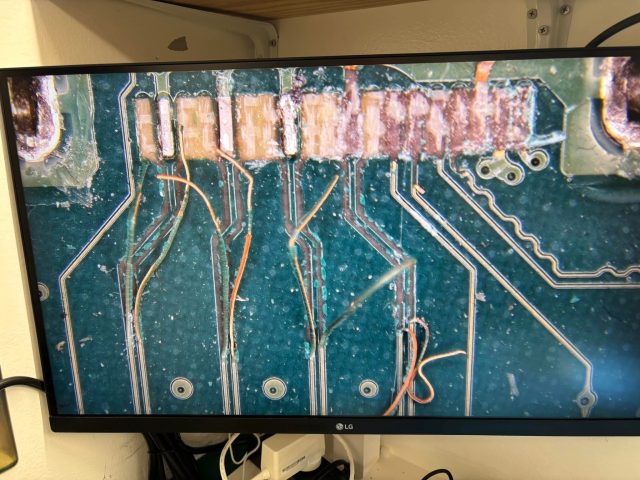
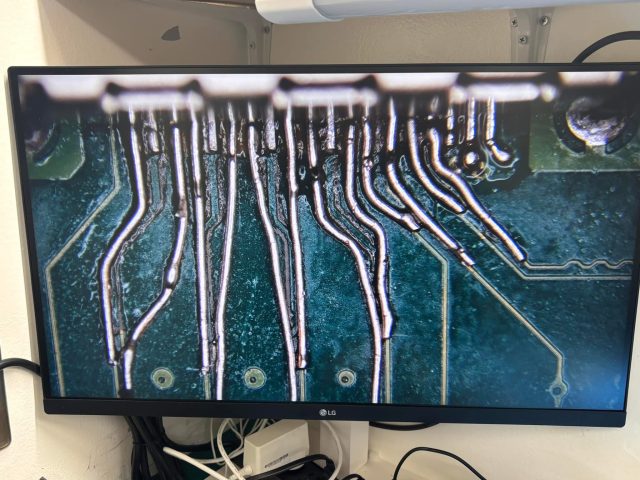
During inspection of the Xbox Series X motherboard, we found that the HDMI port area had suffered more extensive damage than a standard HDMI port replacement. Several of the small copper pathways beneath and surrounding the HDMI port had been torn away from the circuit board.
These pathways are known as traces. Traces are extremely thin copper pathways built into the motherboard. They function like microscopic wires, carrying electrical signals and power between the HDMI port and the other components responsible for producing video and audio.
On an Xbox Series X, the HDMI port contains multiple connections responsible for:
- High-speed video and audio data
- HDMI device detection
- Display communication
- Power and grounding
- Resolution and refresh-rate negotiation
- HDCP communication and display authentication
When an HDMI port is physically damaged, pulled sideways, or removed improperly, the solder pads and traces beneath the port can be lifted or completely torn from the motherboard. Once that happens, installing a new HDMI port by itself will not restore the connection because the replacement port would have nothing electrically connected beneath the damaged pins.
Damage Found
After removing the damaged HDMI port and cleaning the area, we identified multiple missing or damaged pads and traces. Several connections could no longer reach their original solder points.
This required rebuilding the damaged electrical pathways manually before a replacement HDMI port could function correctly.
Repair Process Performed
The damaged HDMI port was first removed using hot air, flux, and low temp solder. The motherboard was then cleaned to remove old residue and damaged material so the condition of each connection could be evaluated under magnification.
Each HDMI pin location was inspected individually to determine:
- Which pads were still intact
- Which traces had been partially damaged
- Which connections had been completely torn away
- Where each damaged signal originally traveled on the motherboard
- Whether any nearby traces or components had been shorted or disturbed
For the missing connections, the protective coating over the remaining copper traces was carefully scraped away to expose a usable section of copper. Very fine insulated jumper wire was then soldered from each damaged trace to the correct HDMI port pin location.
These jumper wires act as replacement pathways for the missing sections of the motherboard.
Because the HDMI circuit carries extremely high-speed signals, the routing of these wires is important. Each wire must be:
- Connected to the correct HDMI pin
- Kept as short as reasonably possible
- Routed away from neighboring contacts
- Properly insulated
- Secured so movement of the port cannot pull the repair loose
- Checked carefully for bridges or shorts
The repaired connections were then tested with a multimeter for continuity between the HDMI port and the corresponding points farther along the circuit. Each line was also checked against neighboring pins and ground to confirm that no unintended connections were present.
After the trace reconstruction was completed, the replacement HDMI port was aligned and soldered to the motherboard. The port’s larger mounting legs were secured to provide mechanical support, while the smaller signal pins were soldered to either the original pads or the newly reconstructed trace connections.
The repair area was then cleaned and inspected again under magnification.
Why This Is More Involved Than a Normal HDMI Port Replacement
A normal HDMI port replacement involves removing the damaged port, cleaning the original solder pads, and installing a new port.
A trace repair is significantly more difficult because the motherboard itself has been damaged. The technician must manually recreate the missing circuitry one connection at a time.
In this case, the final repair involved numerous precision jumper wires because several of the original HDMI pathways were no longer present. This type of work requires microsoldering equipment, high magnification, careful signal mapping, and extensive testing.
Final Testing
Once the port and reconstructed traces were installed, the Xbox was reassembled enough to perform functional testing. Testing included:
- Confirming the console powered on normally
- Checking for a stable HDMI connection
- Confirming video output to a display
- Verifying that the display remained connected without flickering or signal loss
- Checking that the HDMI cable fit securely
- Testing for shorts around the repaired HDMI circuit
- Confirming continuity through the reconstructed traces
- Inspecting the repair area for loose wiring or solder bridges
Repair Summary
The Xbox Series X did not only require an HDMI port replacement. The motherboard had sustained substantial trace and pad damage beneath the HDMI connector.
To complete the repair, we manually rebuilt the missing HDMI connections using precision jumper wires, restored continuity between the HDMI port and the motherboard, installed and secured a replacement HDMI port, and tested the repaired circuit for proper operation.
Because the reconstructed wires are replacing pathways that were originally manufactured inside the motherboard, extra care should be taken when connecting or disconnecting HDMI cables. Avoid placing sideways or downward pressure on the cable, and always remove the cable by gripping the connector rather than pulling on the cord.